
When Should a Microfluidic Device Move from PDMS to Injection Molding?
Updated: Aug 10
Microfluidics manufacturing at scale demands more than a good prototype. The path from a validated PDMS chip to a reproducible, production-ready custom microfluidic device is where most R&D programs stall and microfluidic injection molding is how the best teams cross that gap.
The Reproducibility Wall Every Researcher Hits
Microfluidics manufacturing is a discipline with a reproducibility problem and it starts long before production. You've validated the assay. The droplet generation is consistent, in your hands, on your bench, with your protocols. The paper is written. Then someone asks: "Can we scale this? Can another lab reproduce it?"
That's the moment most microfluidic R&D programs discover they've been building on sand. PDMS (polydimethylsiloxane) is a brilliant material for rapid prototyping. It's oxygen-plasma bondable, optically transparent, gas-permeable, and you can cast a new chip in an afternoon. But it is not a manufacturing material. It is a research material.
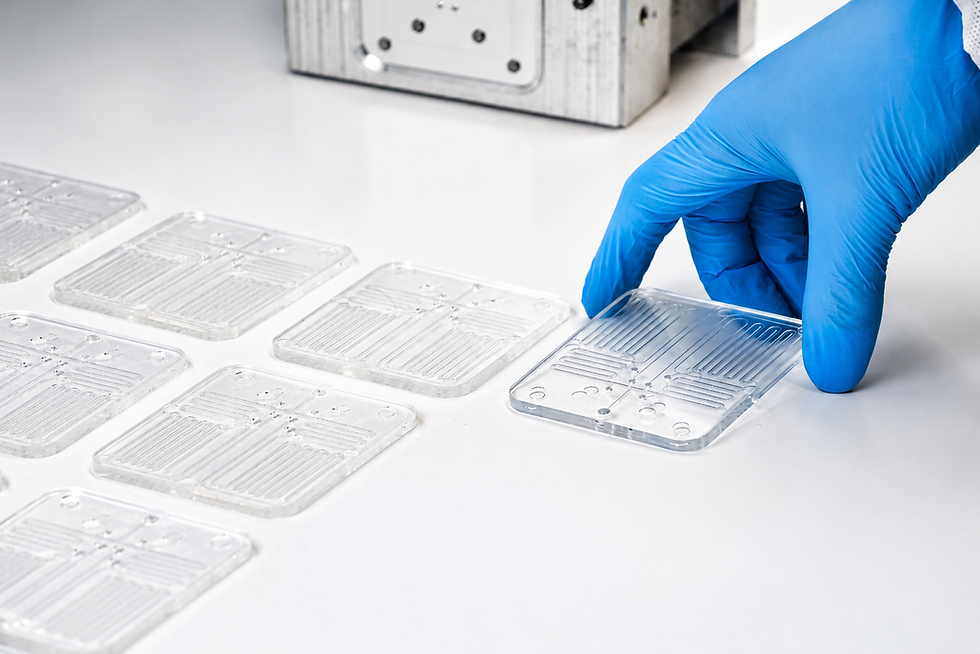
The hidden cost of PDMS at scale: Channel dimensions vary by ±15–20% batch-to-batch depending on curing temperature, mixing ratio, and bake time. Surface chemistry changes over hours after plasma treatment. Small molecules, drugs, dyes, signaling lipids, absorb into the bulk at rates that vary with batch. For quantitative assays, this isn't a minor inconvenience; it's a systematic error source.
The transition from PDMS prototyping to thermoplastic injection molding is therefore not a manufacturing upgrade, it's a scientific one. It's the point at which your device stops being a handmade instrument and becomes a reproducible, characterizable substrate. It's when your microfluidic research becomes microfluidic technology.
This article is for R&D engineers who are ready, or nearly ready, to make that transition. We'll cover the engineering rationale, the material science, the process architecture, and the practical steps to commissioning custom microfluidics manufacturing through injection molding.
Why Injection Molding Is Ideal for Custom Microfluidic Chips
Injection molding is the dominant manufacturing process for polymer precision components for a simple reason: it enforces geometric repeatability through physics, not operator skill. Once a mold is qualified, every cycle reproduces the same cavity geometry, the same channel cross-sections, the same surface roughness, the same feature depths, within validated tolerances.
For microfluidics manufacturing, this matters at a fundamental level. Pressure drop in a rectangular microchannel scales as the fourth power of hydraulic diameter (Hagen–Poiseuille regime). Even small variations in channel dimensions can lead to significant changes in fluidic performance.In PDMS, that variation is routine. In a precision-molded thermoplastic chip, the product of microfluidic injection molding, it's controlled. And when you're working with feature dimensions in the 10–500 µm range. At these dimensions, process control becomes critical for achieving reliable and repeatable assay performance.
50–500 µm
Typical channel dimension range in precision injection-molded microfluidic chips
Shot-to-shot consistency as a scientific asset
When you run an experiment with injection-molded chips, you're not fighting your substrate. Every chip in the lot is manufactured to the same validated geometry and process parameters. That means your N is really N — not N chips with hidden chip-to-chip variance baked in. Statistical power goes up. Outlier investigation becomes meaningful. Platform studies across sites become feasible.
Scalability without redesign
Perhaps the most strategically valuable aspect of custom microfluidics manufacturing via injection molding is that the same manufacturing platform can support both prototyping and volume production, minimizing the need for process changes during scale-up.The tooling that validates your design at prototype scale is the tooling, or a direct extension of it, that runs your production lot. There are no new bonding chemistries to validate, no new surface treatments to qualify, no batch-to-batch material variation to characterize. The design is fixed in steel and aluminum. This is not possible with any soft-lithography approach at scale.
PDMS soft lithography | Thermoplastic injection molding |
|
|
Material Selection for Custom Microfluidic Chips
The choice of thermoplastic is not a commodity decision in microfluidics. It determines optical transmission, autofluorescence background, surface chemistry, chemical compatibility, and the minimum feature size achievable under production conditions. Here's what matters for each major candidate:
Material | UV Transmission | Autofluorescence | Chemical Resistance | Best For |
COC (cyclic olefin copolymer) | Excellent (>300 nm) | Very low | Good (most aqueous, some organic) | Fluorescence assays, diagnostics |
COP (cyclic olefin polymer) | Excellent (>300 nm) | Very low | Good (similar to COC) | Cell culture, optical detection |
PMMA (acrylic) | Good (>350 nm) | Low–moderate | Moderate (avoid strong solvents) | Cost-sensitive, high-clarity applications |
PC (polycarbonate) | Moderate | Moderate | Moderate–low | Structural components, thermal stability |
PS (polystyrene) | Good (visible) | Moderate | Moderate | Cell biology (established protocols) |
Engineering note on COC/COP: Both cyclic olefin materials have near-zero water absorption (<0.01%), making them exceptional for assays sensitive to hydration state. They also lack the ester groups that cause PMMA to hydrolyze under aggressive sterilization conditions. For IVD and clinical applications, COC/COP are often the path of least resistance through biocompatibility qualification, both have established USP Class VI and ISO 10993 data packages.
The molding constraint on material choice
Cyclic olefin polymers have high melt viscosities and relatively high glass transition temperatures (Tg typically 70–170°C depending on grade). This means filling micro-scale features requires careful thermal management of both mold and melt, a capability that separates specialty microfluidic molders from general-purpose injection molders. Processing (dynamic mold temperature cycling) is often essential for feature depths below 50 µm in high-Tg grades.
Custom Microfluidic Chip Manufacturing at Micromolds
Custom microfluidics manufacturing via injection molding is not a single step, it's a stack of tightly coupled engineering disciplines that must remain aligned from the first CAD commit to the final inspection report. Here's how Micromolds structures that stack:
Design for Manufacturability (DfM) Review
Before tooling is cut, the microfluidic architecture is analyzed for microfluidic injection molding constraints: draft angles, wall thickness gradients, gate placement, and weld-line positioning relative to critical flow features. Designs developed with injection molding in mind from day one eliminate the most expensive iteration loops.
Mold Tooling — Prototype or Bridge
Prototype tooling (1–3 week lead time) enables functional validation under production-like conditions before committing to hardened production steel. Space-grade aluminum alloys with fine crystalline microstructure (±2 µm) allow feature replication that rivals steel tools, at a fraction of the cost and time. Bridge tooling enables low-volume pre-production runs while the final production tool is being qualified.
Micro Injection Molding
Microfluidics injection molding help ensure complete replication of fine microfluidic features by minimizing polymer melt hesitation during filling. Critical process parameters, including injection speed, packing pressure, mold temperature profile, and cooling time, are tightly controlled and documented for every production lot. Typical channel dimensions range from 100–500 µm in standard production, while sub-100 µm channels and features can be achieved in selected applications following design review and feasibility assessment.
Bonding & Sealing
Microfluidics bonding process selection depends on channel geometry, pressure requirements, and whether optical access through the bond plane is required. Each method has tradeoffs in minimum channel dimension preservation and burst pressure.
Metrology & Quality Control
Dimensional verification uses optical profilometry and confocal microscopy. When measurement system variation approaches part variation, a common challenge at the micro scale, Gage R&R studies are essential to distinguish process drift from measurement noise. 100% in-house capability means no tolerance on inspection lag.
Cleanroom Packaging & Delivery
Production microfluidic components are handled, inspected, and packaged in controlled environments. Contamination at the chip level, particulates in sub-200 µm channels, can invalidate entire production lots. In-house cleanroom capability eliminates transfer risk.
Tolerances, Features & What's Actually Achievable
Claims about achievable feature sizes in micro injection molding are common. What's less common is a frank account of the conditions required to hit them reliably, at production volume, in the materials that matter for microfluidics.
Production capability benchmarks — Micromolds
Parameter | Performance |
Minimum channel width | 50–100 µm (down to 10–20 µm for selected applications) |
Minimum channel depth | 20–50 µm (down to 5–10 µm) |
Dimensional CV (width, lot-to-lot) | Typically within ±5–10 µm, depending on geometry and material |
Channel aspect ratio (depth:width) | Up to 1:5 |
Surface roughness Ra | ~50 nm depending on mold insert finish |
Parts per cavity per cycle | 1–2 (micro cavities) |
Prototype tooling lead time | 1–3 weeks |
Production tooling lead time | 6–8 weeks |
Production volumes | From prototyping to mass production |
One underappreciated constraint: mold surface finish directly determines channel wall roughness, which affects both optical clarity and the stability of electroosmotic flow (EOF) if you're running electrophoretic separations. Electropolishing of mold inserts, combined with traditional optical polishing, can achieve channel walls with Ra <10 nm, sufficient for single-molecule imaging applications and low-noise impedance spectroscopy.
For simulation-driven projects: Micromolds collaborates with specialized microfluidics partners for complex computational fluid dynamics (CFD) validation and multi-physics simulation of device behavior under production geometry constraints, not just the idealized CAD model.
Transitioning from PDMS: A Practical Roadmap
The most common question from R&D teams approaching custom microfluidics manufacturing for the first time: "Can we just translate our PDMS design directly into plastic?" The honest answer is: sometimes yes, often not without modifications and the modifications are almost always worth making.
What transfers well
Channel topology, valve geometry (if translated to a rigid-body design), junction architecture, and overall chip footprint all transfer straightforwardly. If your PDMS chip is running a well-understood flow regime, pressure-driven laminar flow, simple droplet generation, passive mixing, the physics transfers cleanly into a thermoplastic equivalent once channel dimensions are adjusted for any shrinkage or material-specific flow resistance differences.
What requires redesign
PDMS chips rely on the material's elasticity for certain valve types (Quake-style pneumatic valves, for example). These do not translate to rigid thermoplastics. Similarly, PDMS chips often have features with high aspect ratios that are easy to cast but difficult to demold from a steel insert. DfM review at Micromolds specifically targets these incompatibilities early, before tooling investment.
Surface chemistry is the other major transition challenge. PDMS becomes hydrophilic after oxygen plasma, but reverts to hydrophobic over 24–72 hours. Thermoplastics like COC and PMMA can be surface-functionalized using UV/ozone treatment, aminosilane chemistry, or plasma treatment and these modifications are stable, reproducible, and scalable in a way that PDMS plasma activation is not.
Recommended transition protocol: (1) Begin with PDMS prototyping of functional architecture. (2) Transition to thermoplastic CNC-milled or micro-milled chips for critical feature validation under production-material properties. (3) Commission prototype injection mold tooling for first production-representative lot. (4) Qualify dimensional stability and assay performance before committing to production tooling. Micromolds supports each stage of this workflow.
Applications of Custom Microfluidic Chips
Custom microfluidics manufacturing via injection molding has moved well beyond academic labs. Here are the application areas where demand is strongest and where the engineering constraints are most acute:
Point-of-care diagnostics (IVD)
Lateral flow is mature. The next generation of POC diagnostics requires quantitative, multiplexed detection and that means microfluidic chips. Regulatory path (CE IVD, FDA 510(k)) demands manufacturing controls that only injection molding can deliver: documented tolerances, validated process parameters, lot traceability, and biocompatibility dossiers. COC and COP are the materials of choice.
Organ-on-a-chip and microphysiological systems
Organ-on-chip research is transitioning from PDMS proof-of-concept toward commercial instruments. The absorption of lipophilic drugs and signaling molecules into PDMS is a well-documented confound in pharmacological studies. Thermoplastic chips with ultra-low absorption profiles (COC/COP) are enabling the kind of quantitative pharmacokinetic data that drug developers actually need.
Digital PCR and nucleic acid analysis
Droplet digital PCR (ddPCR) chips require monodisperse droplet generation at kHz frequencies with <2% coefficient of variation in droplet volume. This is a geometry problem at its core, it demands channel dimensional stability that injection-molded thermoplastics provide and PDMS fundamentally cannot guarantee at scale.
Cell sorting and single-cell analysis
Deterministic lateral displacement (DLD) arrays, inertial focusing channels, and acoustofluidic separation devices all rely on feature dimensions in the 5–50 µm range, with tight tolerances on pillar-to-pillar spacing and channel width. These are exactly the features where injection molding's ability to replicate sub-10 µm structures from a precision-polished insert becomes mission-critical.
Industrial and environmental monitoring
Continuous flow chemistry, inline analytical devices, and microreactors for process monitoring are driving demand for chemical-resistant thermoplastic chips at high volumes. The economics here strongly favor injection molding over any batch fabrication method once volumes exceed a few hundred units per year.
How to Start Your Custom Microfluidics Project
The most common mistake: waiting until you're "ready." In practice, the earlier you engage a microfluidics manufacturing specialist, the fewer expensive redesign cycles you'll face. DfM constraints, features that can't demold reliably, wall thicknesses that cause sink marks, gate locations that create weld lines across critical features, are cheapest to address when they're still lines in a CAD file.
At Micromolds, the engagement process is designed to move fast:
Upload your CAD file or describe your project
STEP or a sketch with key dimensions. The Micromolds engineering team reviews for manufacturability and responds with a feasibility assessment and quote.
Receive DfM feedback and production quote
Within days, not weeks. Feedback covers tooling strategy, material recommendation, and any geometry modifications that improve yield or reduce tooling cost.
Tooling fabrication begins
All mold design and manufacturing is 100% in-house, CNC milling, EDM, surface finishing, electropolishing, at Micromolds facilities in Lithuania, EU.
First parts, inspection, iteration
Prototype parts arrive with dimensional reports. Tooling modifications (if needed) are completed in-house, typically within days. No outsourcing lag.
Scale to production
Once the design is locked, the same tooling infrastructure scales from hundreds to hundreds of thousands of chips without process change or re-qualification.
Whether your project is at the napkin-sketch stage or ready to transition from validated PDMS prototypes, the right moment to start a conversation about microfluidics manufacturing is now, not after your next funding round.
Not Sure if Your Design Is Ready for Injection Molding?
Upload your CAD file or describe your device.
We'll review it and send you a feasibility report and quote.
Frequently Asked Questions
What is microfluidics manufacturing and how does injection molding differ from standard plastic molding?
Microfluidics manufacturing refers to the end-to-end process of producing microfluidic chips, devices containing microscopic channels, chambers, and functional features designed to manipulate small volumes of fluids with high precision. Microfluidic injection molding specifically requires ultra-precise mold tooling (EDM-machined inserts), mold temperature control and dimensional verification at the micron level. Standard injection molding handles millimeter-scale features and tolerances; microfluidic injection molding operates at significantly smaller scales and tighter tolerances. At Micromolds, the entire process, from DfM review and tooling development to molding, bonding, inspection, and cleanroom packaging, is optimized for custom microfluidic devices.
How small can channel features be in injection-molded microfluidic chips?
In standard production, Micromolds typically manufactures microfluidic channels with dimensions ranging from 100–500 µm, depending on geometry, material, and application requirements. For advanced designs, sub-100 µm channels and microfeatures may be achievable through optimized tooling, material selection, and process development.
Which materials are best for microfluidic injection molding: COC, COP, or PMMA?
The optimal material depends on the requirements of your application.
COC (Cyclic Olefin Copolymer) and COP (Cyclic Olefin Polymer) are widely used in microfluidics due to their excellent optical clarity, low water absorption, low autofluorescence, and good chemical resistance. They are particularly well suited for fluorescence-based assays, diagnostics, and life science applications.
PMMA (Acrylic) is a cost-effective option that offers high optical transparency and ease of manufacturing, making it suitable for many analytical and disposable microfluidic devices.
Polycarbonate (PC) is often selected when higher impact resistance or thermal stability is required.
Material selection should consider optical performance, chemical compatibility, bonding requirements, sterilization methods, and regulatory expectations. During the feasibility phase, we help determine the most suitable material for your device and manufacturing goals.
Can I transition my existing PDMS prototype directly to injection molding?
Often yes, with some modifications. Channel topology, junction geometry, and overall chip layout typically transfer well. Features that rely on PDMS elasticity, such as Quake-style pneumatic valves, need to be redesigned for rigid thermoplastics. Very high aspect ratio features (depth:width > 1:5) may require geometry adjustments for demolding. The good news: these modifications are almost always minor and are identified during DfM review before any tooling is ordered. Most teams are surprised by how straightforward the transition is once they have expert guidance.
What are the minimum order quantities for custom microfluidic chips?
There is no strict minimum. Micromolds works with R&D teams needing as few as 50–200 prototype chips to validate an assay, all the way through to commercial runs of hundreds of thousands of units per year. Prototype tooling is designed to be cost-accessible for early-stage projects, and the same tooling infrastructure scales to production without process re-qualification. The economics of injection molding become increasingly favorable compared to alternatives once you exceed a few hundred chips per year.
How long does it take to get first injection-molded microfluidic parts?
Prototype tooling typically takes 1–3 weeks from design sign-off to first parts. Because all mold design, CNC machining, EDM, and surface finishing are done in-house at Micromolds, there are no outsourcing delays or communication gaps. If tooling modifications are needed after first-article inspection, they are usually completed within days. Production tooling lead times are longer but are scoped during the project planning phase so you can align with your development timeline.
Does Micromolds offer bonding and full device assembly, or only molded parts?
Micromolds provides the full manufacturing stack, including channel layer molding, lid/cover layer production, and bonding. Finished, sealed microfluidic chips are inspected, dimensionally verified, and packaged in controlled environments.
Is microfluidics manufacturing from Micromolds suitable for IVD and regulated applications?
Yes. Micromolds operates with the documentation and process control discipline required for IVD development, including lot traceability, dimensional inspection reports, and validated process parameters. Material options include grades with established USP Class VI and ISO 10993 biocompatibility dossiers. We work with teams navigating CE IVD and FDA 510(k) pathways and understand the manufacturing evidence requirements those processes demand. Contact us early in your regulatory timeline, manufacturing documentation is far easier to build from the start than to reconstruct retroactively.


Comments