
Microfluidic Materials: Why Thermoplastics Replace Glass in Production
Updated: Apr 14
Microfluidic devices are increasingly used in diagnostics, life science research, and point-of-care applications. As concepts move closer to real-world deployment, engineers face a key decision: which material allows a smooth transition from prototype to scalable production?
For decades, glass and silicon were the standard substrates thanks to their optical and structural properties. However, they present manufacturing limitations that slow down development, reduce design flexibility, and increase cost.
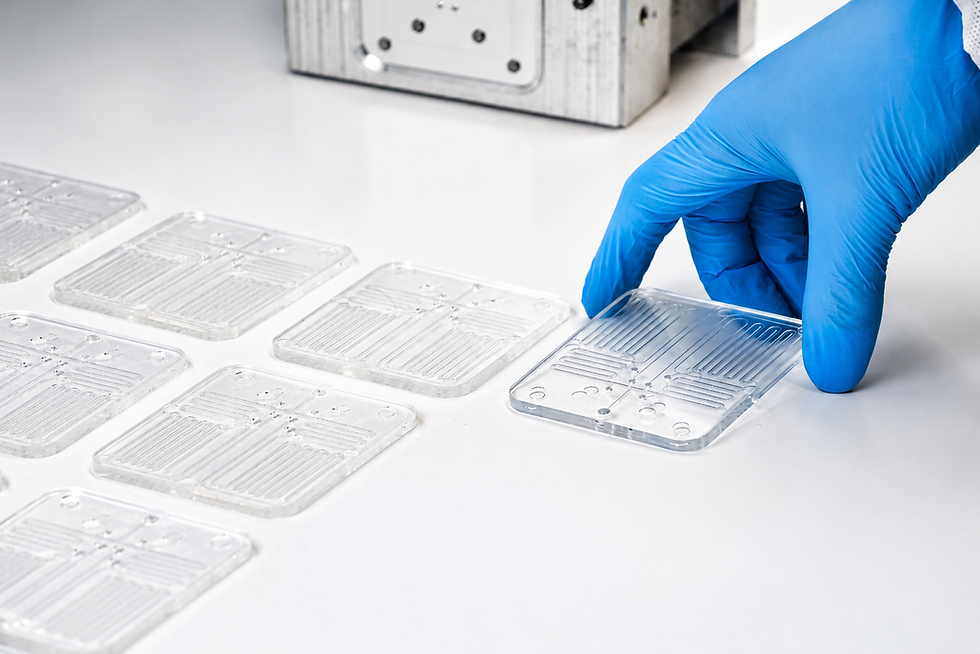
Modern thermoplastics, especially COC/COP, PS, and PMMA, offer a practical alternative. They combine high optical clarity, biocompatibility, and compatibility with mass-production processes such as micro injection molding. This makes them a strong option for teams aiming to scale efficiently while maintaining device performance.
Choosing the right substrate material is critical not only for prototype validation but also for successful commercialization. In this article, we compare thermoplastics, glass, and silicon for microfluidic chip fabrication — and explain which material best supports scalability, cost-efficiency, and real-world functionality.
Key Advantages of Thermoplastics for Microfluidic Chips
Unlike glass or silicon, thermoplastics support both rapid prototyping and scalable manufacturing – making them ideal for R&D teams, startups, and medical device manufacturers looking to shorten development cycles without compromising performance.
Thermoplastics offer several key advantages for lab-on-a-chip fabrication and microfluidic device manufacturing:
Scalable manufacturing through injection molding
Lower per-unit cost after tooling is established
CNC-friendly for early prototyping and design verification
High optical transparency, suitable for imaging and fluorescence detection
Multiple bonding options (thermal, solvent, ultrasonic, laser)
These features make thermoplastics especially attractive for droplet microfluidics, single-cell analysis, and point-of-care diagnostic platforms. They allow engineers to move predictably from design to production — a critical factor in regulated industries.
Learn more about materials used in microfluidic manufacturing >>>.
Comparison of Glass, Silicon, and Thermoplastics in Microfluidics
Each material, glass, silicon, and thermoplastics, offers distinct advantages and trade-offs in microfluidic manufacturing. To help engineers and decision-makers evaluate the most suitable option, the table below compares them across critical factors such as fabrication method, setup cost, optical clarity, scalability, and design iteration speed.
Property | Glass | Silicon | Thermoplastics (COC/COP/PS/PMMA) |
Fabrication method | Wet/dry etching | Photolithography | Injection molding, CNC machining |
Setup cost | High | Very high | Moderate |
Lead time | Long | Long | Short |
Minimum feature size | ~10–20 µm | ~1–5 µm | ~5–10 µm |
Optical clarity | Excellent | Low | Excellent (COC, PMMA) |
Chemical resistance | Very high | High | Moderate to high (material-dependent) |
Bonding complexity | High (anodic, fusion) | High (plasma) | Low to moderate |
Scalability | Limited | Limited | High |
Design iteration speed | Slow | Very slow | Fast |
Source: ResearchGate, 2024; Micromolds internal analysis; Microfluidics Innovation Center
Why Glass Is Being Replaced
Glass microfluidic chips are known for their chemical inertness, transparency, and pressure resistance. However, several factors limit their use in commercial applications:
Multi-step etching processes
High-temperature or anodic bonding
Brittle handling properties
Long manufacturing lead times
Limited flexibility for design changes
Glass is suitable for specialized research devices but often impractical for commercial production.
Why Silicon Has Lost Ground
Silicon has long been used in MEMS manufacturing and remains essential for integrated sensor systems. However, for general microfluidics, it presents critical challenges:
Opaque surface restricts optical detection
Requires cleanroom facilities
High cost per unit
Fragile, prone to chipping
Limited scalability due to mask-based processing
Silicon is now mostly used for integrated sensor applications rather than fluidic structures.
Why Thermoplastics Fit Modern Manufacturing Needs
Compared to traditional materials, thermoplastics have emerged as the preferred material for scalable microfluidic production.
They effectively address the limitations seen with glass and silicon by offering:
Support high-volume injection molding
Enable rapid prototyping through CNC machining
Provide consistent replication of micro-features
Reduce manufacturing cost at scale
Offer multiple bonding options to suit different designs
For many diagnostics and life science applications, thermoplastics strike an effective balance between performance, cost, and manufacturability. Thermoplastics such as COC and PMMA are widely used in commercial diagnostic cartridges (e.g. COVID-19 tests), organ-on-a-chip systems, and single-cell droplet microfluidics platforms.
Explore more about microfluidic fabrication>>>.
Frequently Asked Questions
Is COC better than glass for diagnostics?
For most diagnostic applications, COC offers comparable clarity with significantly faster and more cost-effective manufacturing.
Can thermoplastics achieve similar feature sizes to silicon?
While silicon can achieve slightly smaller features, thermoplastics meet the resolution requirements (~5 µm) for most applications.
Are thermoplastic chips reliable for clinical use?
Yes. COC/COP, PS, and PMMA are already used in cleared medical devices and provide biocompatibility, chemical stability, and robustness.
Does Micromolds support both prototyping and mass production?
Yes. We offer CNC prototyping and full-scale micro injection molding under one roof, ensuring a smooth path from idea to market
Request a Microfluidic Manufacturing Consultation
Not sure which material best suits your application?
Request a free review with our engineering team — we’ll assess your design and propose a scalable path to production.


Comments